Skip to content
AnantCausal
Closed loop

Act on the decision, then check what happened.

Most causal tools stop at the answer. AnantCausal also carries the decision out under guardrails, measures it honestly, and scores the model against the result.

A decision that is only recorded cannot be tested. The loop here is observe, model, decide, act, measure, learn — and each step keeps what it claimed beside what happened, so the model is held to its own numbers.

The closed loop

  1. Model: Variables, structure, sourced probabilitiesLeads to: Check the question
  2. Check the question: Answerable from this model?Leads to: Decide (answerable)
  3. Decide: Effect with a band, approved by a named personLeads to: Act under guardrails
  4. Act under guardrails: Assign, ramp, stop rulesLeads to: Measure and learn
  5. Measure and learn: Experiment, scored against the claimLeads to: Model (corrects the model)
  6. Keydiamond: A check before acting; emphasis edge: The path when the answer is yes; dashed: What was learned, fed back
A decision is modeled, checked for whether the question can be answered, carried out under guardrails and measured, and what was measured corrects the next decision.
Act

Carry the decision out without losing track of who got what.

Assignment and rollout are deterministic and recorded, so a later analysis can say exactly who was meant to be treated.

Who is treated, and who is not

  1. Units: With the attributes you sendLeads to: Eligibility rule
  2. Eligibility rule: Missing means not placedLeads to: Stable hash placement
  3. Stable hash placementLeads to: Holdout; Comparison; Treated
  4. Holdout: Fixed for the whole run
  5. Comparison
  6. Treated: Share ramps up, never down
  7. Keystack: Many units, one rule; diamond: A rule applied to every unit; muted: Never treated; good: Treated; the share only grows
Units are checked for eligibility and placed by a stable hash into a fixed holdout, a comparison group and a treated share that can only grow, so nobody is reshuffled mid-run.

Dry run

See the arm counts, a sample from each arm and a cost estimate before anything is sent. A dry run writes nothing.

What this does not establish: The cost is an estimate from what you configured, not a quote from the system that will deliver the treatment.
Stable assignment with a fixed holdout

Each unit is placed by a hash of the intervention, a salt and the unit, and the placement is recorded once. Raising the treated share never reshuffles anyone, and the holdout stays fixed.

What this does not establish: Independent assignment balances arms in expectation, not in a small sample; stratified assignment below is the answer to that.

Eligibility and audiences

An intervention can declare who is eligible, inline or pinned to one version of a named audience. A unit with a missing attribute is reported as unknown and is not placed — never silently matched or mismatched. An audience can be exported as a SQL predicate for your warehouse.

What this does not establish: The platform holds no per-person data, so an audience is a rule, not a list. The rule language is deliberately small: comparisons combined with all, any and not.

Cluster and stratified assignment

Everyone sharing an attribute, such as a store, gets the same arm. Or arms are balanced exactly within each combination of attributes, across batches, and a unit already placed never moves.

What this does not establish: Clustered experiment designs for sizing a test are not built yet; sizing assumes independent units.

Staged rollout

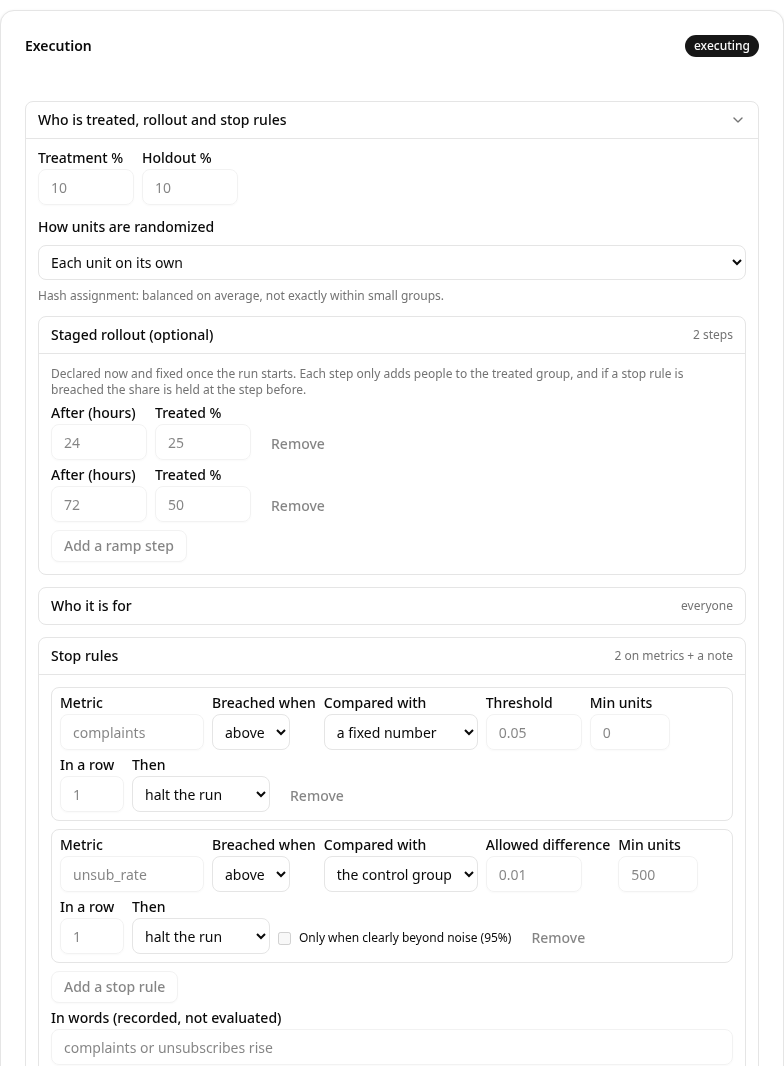
Declare a ramp of treated shares over time. It can only grow the treated share, never reaches into the holdout, and is fixed once the run starts. The share is held one step back while any stop rule is breached.

What this does not establish: There is no automatic ramp down. Stopping is what halt is for.

Execute, confirm, halt

Executing announces the start to subscribed systems. The system that delivers the treatment reports back — started, progress, stopped, failed — and a run that nothing has confirmed after an hour is flagged. Halting always succeeds, even if a vendor is down.

What this does not establish: A delivery report changes no state, and the platform cannot verify a report; it records who sent it.

Stay safe

Stop rules that are written before the run starts.

Execution refuses to start without guardrails, and the rules are frozen while the run is going, so a threshold cannot be moved after seeing results.

A stop rule that compares to control

  1. Treated arm readingLeads to: Difference
  2. Control arm readingLeads to: Difference
  3. Difference: Treated minus controlLeads to: Past the threshold?
  4. Past the threshold?: Units, readings in a rowLeads to: Halt the run (rule says halt); Alert only (rule says alert); Keep running (no)
  5. Halt the run: Names the metric
  6. Alert only
  7. Keep running
  8. Keydiamond: A rule, checked on every reading; bad: Stops the run; watch: Alerts, stops nothing; good: Carries on
A stop rule judges the treated arm against the control arm at the same time, so a metric that moves in both arms does not halt a change that did nothing wrong.

Stop rules on measured metrics

A rule names a metric, a direction, a threshold, an optional minimum sample and an optional number of readings in a row. A breach is audited and announced. Only a rule written to halt stops the run, and the halt names the metric.

What this does not establish: The platform does not invent a reading. Someone, or a metric source below, must report it.

Compared against control

A rule can compare treated minus control at the same time, so a metric that rises in both arms for an unrelated reason does not trip it. It can require the difference to be beyond a 95% interval before it acts.

What this does not establish: That interval is not a sequential test, so repeated looks are not corrected for; use a minimum sample and readings in a row.

Metrics pulled from your warehouse

Register a source and a metric is read on a timer through the same read-only, single-statement, time-limited path as dataset queries. A source that keeps failing is announced, and its rule shows as unread rather than fine.

What this does not establish: A source for a metric no rule watches is refused, and a metric only exists in the platform as far as your query returns it.

AnantCausal console · Execution
The Execution panel of a running decision in the console. Treatment 10 percent and holdout 10 percent, a staged rollout to 25 percent after 24 hours and 50 percent after 72, and two stop rules: complaints above 0.05, and unsubscribe rate above 0.01 compared with the control group, each set to halt the run. The fields are locked because the run has started.
A running decision: the rollout and stop rules are locked once it starts. Console screenshot, synthetic sample decision.
Measure

Read the result as an experiment, not a dashboard.

The model's prediction is written down before the test, so the result is a comparison and not a story.

Design a test

Size a two-arm test for a yes/no outcome from the baseline and effect the approval rested on, accounting for uneven splits and the holdout. For a continuous outcome, size it from a difference and a standard deviation, with an optional CUPED correlation.

What this does not establish: Two arms only. Clustered designs are not supported.

Check the split before the effect

The analysis tests for sample ratio mismatch first. A broken split is reported instead of an effect, with warnings for small cells and for reading early.

What this does not establish: It works from counts per arm, so it cannot check how the counts were collected.

Always-valid reading and CUPED

A yes/no test can be read with a mixture sequential probability ratio test, valid at every look. A continuous test uses Welch's t-test, optionally adjusted by a pre-experiment measure to cut variance.

What this does not establish: The sequential reading uses a normal approximation and needs a scale. A continuous result is in its own units, so it is never scored against the model's probability.

Measured against the model

The result is placed beside the model's predicted band. Record it, and the track record scores the model against what was measured.

What this does not establish: An observational estimate that falls outside its band is a finding about the model, not proof of which was right.

Learn

A model that is corrected by experiments, and says when it moved.

Learning is narrow on purpose. A loop that fits to its own interventions reinforces selection effects, so the model learns only from a clean experiment.

How the model may learn

  1. Recorded experiment: Counts per armLeads to: Split check
  2. Split check: Sample ratio mismatchLeads to: Preview the update (passes); Refused (fails)
  3. Preview the updateLeads to: Apply as a new revision
  4. Refused: Observational, hand-entered, or already used
  5. Apply as a new revision: Approver permission if required
  6. Keydiamond: A gate the experiment must pass; good: A new model revision; bad: Nothing is learned
A model learns only from a recorded experiment whose split passed its check, previewed first and applied as a new revision, never from the results of its own interventions.

Track record

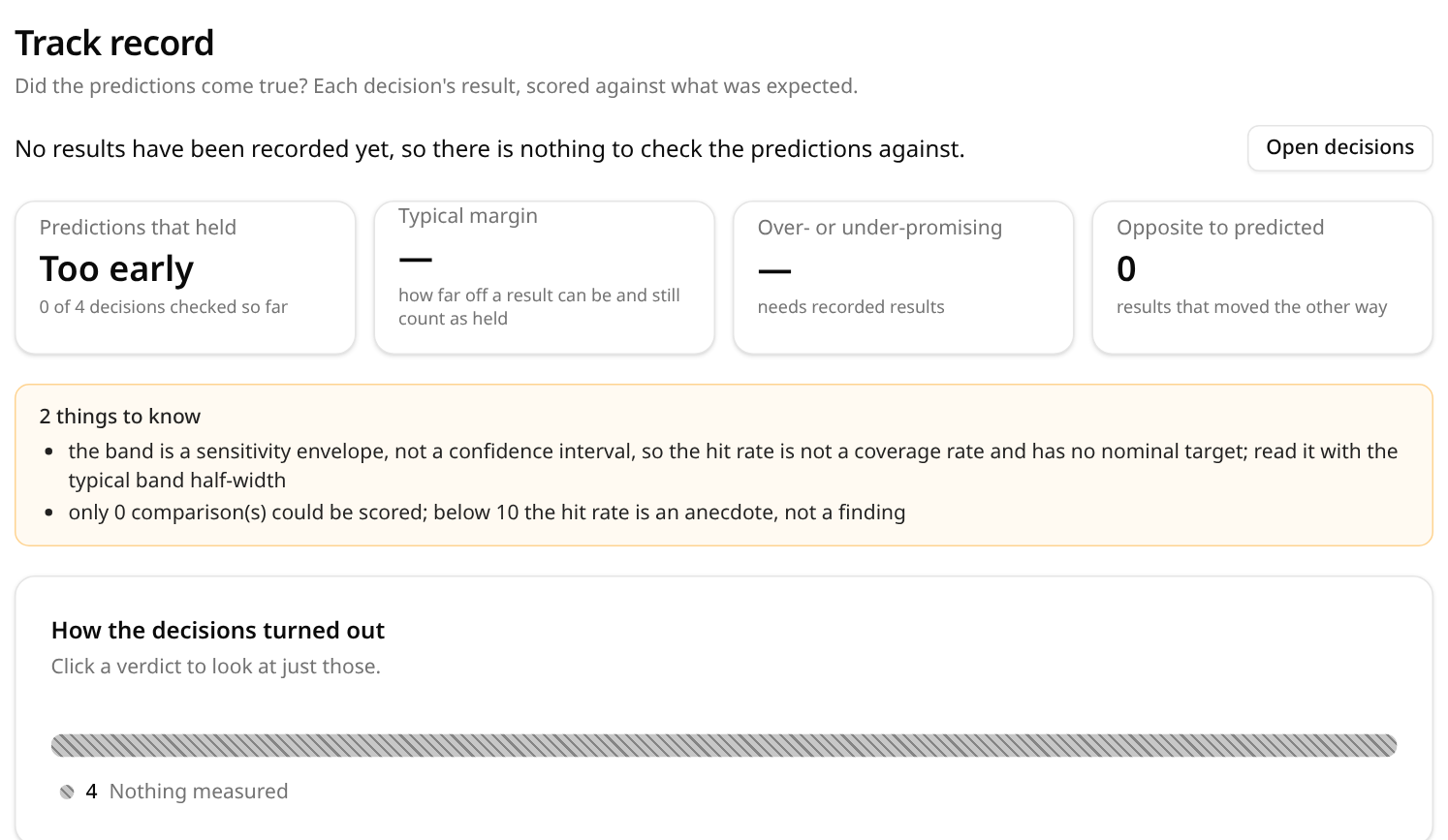
Each decision's latest outcome is scored against the effect and band its approval rested on. The hit rate is reported beside the typical band width, a wrong sign is its own verdict, and an assumption-dependent measurement is reported as not scoreable rather than scored.

What this does not establish: It scores the model against measurements, and a measurement can itself be wrong.

Learn from a recorded experiment

Preview first, then apply: the model's tables are fitted to the arms of a recorded experiment as a new revision, with a prior strength you set. Only a result that passed the split check can be learned from, each result once, and applying needs the approver permission when your project requires it. Approved decisions keep resting on the revision they were approved against.

What this does not establish: It refuses where the arms cannot identify a table: when the outcome has other causes in the model, or is not binary. Counts are as trustworthy as whoever reported them.

Decisions flagged when the answer moves

When a scheduled question that matches a live decision comes back outside the range it was approved on, or pointing the other way, the decision is flagged as needing review and announced once. Dataset refreshes also report which columns, and which relationships, changed.

What this does not establish: A flag changes nothing and stops nothing. Whether the world moved or the model was edited is reported separately, so the two are not confused.

AnantCausal console · Track record
The track record page in the console before any result is recorded: predictions that held read Too early, with 0 of 4 decisions checked so far, the typical margin is blank, and nothing moved the opposite way. A warning beneath says the band is a sensitivity envelope and not a confidence interval, and that below 10 scored comparisons a hit rate is an anecdote and not a finding. All four decisions are shown as Nothing measured.
With nothing measured the track record says Too early, and states its own limits beside the numbers. Console screenshot, synthetic sample decisions.
Who is in control

A person approves and starts it. You set how strict that is.

The platform acts only inside what you configured, and the controls are policy, not convention.

Approver policy

Switch it on and only administrators and members you flag can approve or execute. It is off by default, so an upgrade changes nothing.

Turn on governed execution as well and an intervention can start only through the guarded execute path, which refuses without guardrails.

Anyone can stop it

Halting stays open to every member. Stop rules written beforehand can halt the run automatically, and only if you wrote them to.

Stopping is never gated behind the permission that starting is.

Your systems can drive it

Everything above is an API call, so your own workflow engine can start a run for an approved decision, and your delivery system can confirm it.

The approval and the guardrails still apply; the API does not bypass them.

A recommendation that cannot be acted on, measured and scored is an opinion. The loop exists so that the next decision rests on how the last one actually went.